India has a long tradition of remembering and honoring its national leaders who have shaped the country’s history, values, and democratic foundation. Every year, the birth anniversaries of such eminent personalities are observed with respect and gratitude. One such important occasion is the birth anniversary of Dr Zakir Husain, India’s third President and one of the country’s most respected educationists and statesmen.
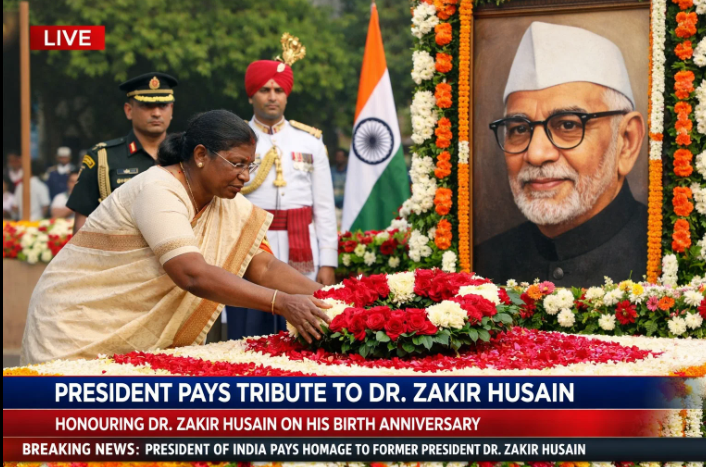
On this significant day, the President of India, Smt Droupadi Murmu, paid floral tributes to Dr Zakir Husain at Rashtrapati Bhavan in New Delhi. The ceremony was a solemn reminder of his immense contribution to Indian society, especially in the fields of education, public service, and nation-building.
This article takes a closer look at the event, the life of Dr Zakir Husain, and why his legacy continues to inspire generations of Indians.
What Happened – The Tribute Ceremony
Every year, the Government of India observes the birth anniversary of Dr Zakir Husain on February 8 with great reverence. This year too, a formal ceremony was organized at Rashtrapati Bhavan to honor his memory.
President Droupadi Murmu paid floral tributes at the portrait of Dr Zakir Husain as a mark of respect. Senior officials, staff members of Rashtrapati Bhavan, and other dignitaries were also present on the occasion. The event followed the traditional protocol observed during commemorations of former Presidents of India.
The ceremony was not just a ritual act but a symbolic gesture acknowledging Dr Husain’s lifelong dedication to education, national unity, and democratic values. Such events help remind citizens of the contributions made by leaders who worked tirelessly to strengthen India after independence.
Through this tribute, the President highlighted the importance of remembering great personalities whose thoughts and actions continue to guide the nation.
Who Was Dr Zakir Husain – A Brief Profile
Dr Zakir Husain was one of the most respected intellectuals and leaders of modern India. He was born on February 8, 1897, in Hyderabad. From an early age, he showed a deep interest in education and social reform.
He pursued higher studies in economics and went on to become one of India’s leading educationists. Dr Husain believed that education was the most powerful tool for national development. His entire life was dedicated to spreading knowledge, promoting cultural harmony, and shaping young minds.
One of his most significant contributions was his association with Jamia Millia Islamia University, which he helped nurture into a premier institution. Later, he also served as the Vice-Chancellor of Aligarh Muslim University, further strengthening India’s academic landscape.
Dr Zakir Husain was not just an academic scholar but also a visionary leader who believed in democracy, secularism, and inclusive growth. His journey from an educationist to the highest constitutional office in India is truly inspiring.
Constitutional Journey – From Governor to President
Dr Zakir Husain’s entry into public service marked the beginning of an extraordinary political career.
- In 1957, he was appointed as the Governor of Bihar, a position he held with dignity and wisdom.
- In 1962, he became the Vice President of India, serving the nation during a crucial phase of its democratic journey.
- In 1967, he was elected as the President of India, becoming the first Muslim to hold this prestigious office.
His presidency was marked by simplicity, integrity, and deep respect for constitutional values. Dr Husain strongly believed that the President’s role was to uphold democratic traditions and remain above party politics.
Sadly, his tenure was cut short when he passed away on May 3, 1969, becoming the first Indian President to die in office. Despite his brief term, his impact on Indian public life remains unforgettable.
Dr Zakir Husain’s Legacy in Education
If there is one field where Dr Zakir Husain left an everlasting mark, it is education.
He strongly believed that a nation could progress only when its people were educated, aware, and enlightened. His vision for education was not limited to textbooks and classrooms. He emphasized:
- Moral and character development
- Scientific thinking
- Cultural understanding
- Social responsibility
As one of the founders of Jamia Millia Islamia, he worked tirelessly to promote modern and inclusive education in India. Under his leadership, the institution became a symbol of academic excellence and national integration.
Dr Husain also wrote extensively on educational philosophy and believed that teachers play a central role in shaping the future of the country.
Even today, many of his ideas about education remain relevant in India’s academic system.
Cultural and Social Impact
Beyond politics and education, Dr Zakir Husain contributed greatly to India’s cultural and social fabric.
He was a strong supporter of India’s pluralistic traditions and believed in unity in diversity. At a time when the newly independent nation was facing many challenges, he worked to promote harmony between different communities.
Dr Husain was also deeply interested in literature, art, and culture. He translated important works into Urdu and Hindi and encouraged cultural exchange between different regions of India.
His life stood as an example of simplicity, humility, and service to the nation. These qualities continue to make him a role model for leaders and citizens alike.
Why India Celebrates Birth Anniversaries of Leaders
India places great importance on remembering its national heroes. Observing birth anniversaries of leaders like Dr Zakir Husain serves many purposes:
- It helps new generations learn about their contributions
- It keeps their ideals alive in public memory
- It strengthens national pride and unity
- It inspires young people to serve the country
Such commemorations are not merely ceremonial. They are reminders of the values on which modern India was built.
By paying tributes to former Presidents and freedom fighters, the nation expresses gratitude and respect for their service.
The Importance of Presidential Tributes
When the sitting President of India honors a former President, it carries deep symbolic meaning.
It reflects:
- Continuity of democratic traditions
- Respect for constitutional offices
- Recognition of past leadership
- Gratitude on behalf of the nation
The tribute paid by President Droupadi Murmu to Dr Zakir Husain was part of this long-standing tradition. It reminded citizens that public service and dedication to the nation are always remembered, even decades later.
Conclusion
The floral tributes paid by the President of India to Dr Zakir Husain on his birth anniversary are more than a ceremonial tradition. They represent the nation’s gratitude to a leader who dedicated his life to education, democracy, and social harmony.
Dr Zakir Husain’s journey from an educationist to the President of India remains an inspiring chapter in Indian history. His ideas about learning, unity, and public service continue to guide India even today.
As citizens, remembering such great leaders helps us stay connected to our roots and values. Their lives remind us that true leadership is not about power but about service, wisdom, and commitment to the nation.
Through these tributes, India renews its pledge to follow the path shown by Dr Zakir Husain and build a stronger, more educated, and more united country.
Frequently Asked Questions (FAQ)
1. Who was Dr Zakir Husain?
Dr Zakir Husain was India’s third President, a renowned educationist, and a respected public leader. He played a major role in strengthening India’s education system and served the nation with integrity.
2. Why is his birth anniversary celebrated?
His birth anniversary is celebrated to honor his contributions to Indian democracy, education, and national unity. It is a way of remembering his service to the country.
3. When did the President pay tribute to him?
The President of India paid floral tributes on February 8, which marks Dr Zakir Husain’s birth anniversary.
4. Who paid the tribute this year?
The current President of India, Smt Droupadi Murmu, paid floral tributes at Rashtrapati Bhavan in New Delhi.
5. What were Dr Zakir Husain’s main contributions?
He contributed immensely to education, served as Vice President and President of India, and worked to promote national integration and democratic values.
6. Where was the tribute ceremony held?
The ceremony was held at Rashtrapati Bhavan, the official residence of the President of India.
7. Why is Dr Zakir Husain important in Indian history?
He was a visionary educationist and the first Muslim President of India, known for his wisdom, simplicity, and dedication to public service.
8. What message does this tribute give?
It shows respect for former leaders and reminds citizens of the importance of education, unity, and constitutional values.
9. How does India honor former Presidents?
India honors former Presidents through official ceremonies, memorial events, and observance of their birth anniversaries.
10. What can young people learn from Dr Zakir Husain?
Young people can learn the values of hard work, education, humility, and service to the nation from his life.